Who We Are
We build wearable, AI-driven medical technologies that monitor vital signals continuously — detecting risks before they become emergencies. Proactive, affordable, intuitive.
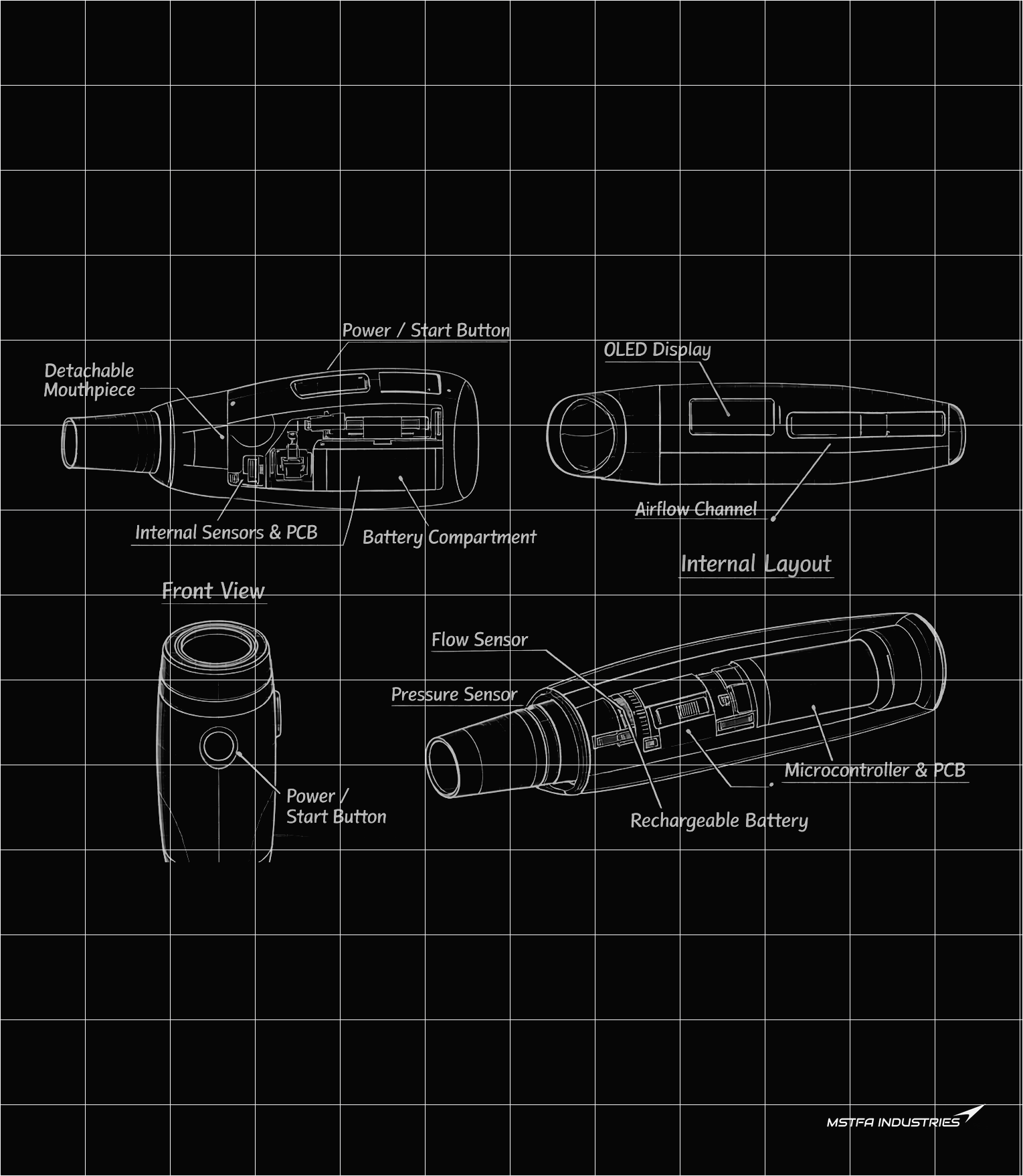
Handheld respiratory AI. FEV1, FVC, PEF with real-time anomaly detection. Measures airflow obstruction patterns consistent with COPD and asthma. Clinic, home, or field.
Predicts migraines, stress, and neural episodes before onset. EEG alpha/beta/theta band analysis, HRV, skin conductivity. Gentle haptic intervention system worn behind the ear.
"Predict, don't react. That's the only standard that matters in healthcare AI."
Our Devices
Three hardware biosensors (Neura, Spira, Pharyna) and one educational web product (LabLens AI), all converging through Plexus — our FHIR-native data plane. Each product targets a critical gap in modern healthcare where AI changes outcomes — measuring what traditional devices miss.
Handheld inhaler-form device that captures FEV1, FVC, and Peak Expiratory Flow in real time, running a trained AI model that builds personalized lung baselines and detects anomalies consistent with COPD, asthma, and restrictive lung disorders.
Discreet 52mm patch worn behind the ear. Predicts migraines and stress events 30 minutes to 6 hours before onset by detecting high beta EEG elevation, RMSSD decline, EDA spikes, and peripheral temperature drops simultaneously.
Flexible adhesive patch worn on the anterior neck that continuously monitors swallowing and detects silent aspiration — material passing below the vocal folds with no cough reflex — in real time using sEMG and acoustic AI fusion, alerting caregivers and giving clinicians longitudinal dysphagia data for the first time.
Free, public, browser-based educational tool. Paste any lab report — blood test, CBC, CMP, lipid panel, thyroid, urinalysis — and receive a marker-by-marker plain-language explanation in seconds. Strictly educational and intentionally outside FDA scope; designed to help people have a more informed conversation with a licensed clinician.
Clinical Intelligence
Clinical-grade metrics, AI-powered interpretation, and real predictive value — not just another health tracker.
Core Spirometry Metrics
Volume of air forcefully exhaled in 1 second. Normal adult: 3.0–4.5L. FEV1 <80% predicted = flag for obstruction. Decreases ~25–30mL/year normally; smokers lose 45–60mL/year.
Total air forcibly exhaled. Normal: 4.0–5.5L (male), 3.0–4.5L (female). FVC <80% predicted = restrictive pattern. Reduced in fibrosis, obesity, scoliosis.
The gold standard COPD diagnostic criterion. Normal: ≥0.70. <0.70 post-bronchodilator = COPD confirmed (GOLD 2026 guidelines). Spira AI applies per-demographic Hankinson regression equations from NHANES 2007–2012 (16,596 subjects).
Maximum flow rate during forced exhalation. Normal male: 8.0–10.0 L/s. Female: 5.5–7.5 L/s. Key asthma monitoring metric — drops before attacks. Measured by Spira's 12–15mm axial sensor chamber via Bernoulli conversion.
AI Risk Classification System
| Normal | FEV1/FVC ≥0.70 · FEV1 ≥80% | No alert |
| GOLD 1 — Mild | FEV1/FVC <0.70 · FEV1 ≥80% | Monitor |
| GOLD 2 — Moderate | FEV1 50–79% | Clinical visit |
| GOLD 3 — Severe | FEV1 30–49% | Urgent referral |
| GOLD 4 — Very Severe | FEV1 <30% | Immediate |
AI Training Data Sources
EEG Band Analysis
Dominant during relaxed wakefulness. Alpha suppression = stress onset. Alpha/Beta ratio <0.8 sustained for >10 minutes is Neura's primary real-time stress signal. Amplitude: 10–50 μV normal.
Strongest migraine predictor in published literature (619-patient QEEG study, 2023). Z-score >1.96 = significant migraine risk signal. OR 1.06 per electrode increase (p=.012). Neura's #1 predictive feature.
Elevated in stress, anxiety, and pre-migraine states. Theta power >1.5× personal baseline = elevated arousal. Theta/Beta ratio >3.0 = stress state. 1–4 hours before migraine onset.
Multimodal Prodrome Detection
| High Beta EEG elevation | 30 min – 6 hrs before | EEG sensor |
| RMSSD decline (<20ms) | 30 min – 2 hrs before | PPG/HRV |
| EDA tonic SCL elevation | 1 – 3 hrs before | EDA contacts |
| Skin temp drop (>0.5°C) | 30 min – 2 hrs before | Temp sensor |
| Alpha power suppression | 1 – 4 hrs before | EEG sensor |
| 0–50 · Baseline | No haptic — background monitoring |
| 50–65 · Elevated | 1 gentle pulse — silent log |
| 65–80 · Warning | 3-pulse breathing cue + app notification |
| 80–90 · High | 4-4-4 breathing pattern + alert |
| 90–100 · Critical | Continuous calm pulse + urgent alert |
How It Works
Purpose-built for biomedical data. Every layer optimized for clinical accuracy and real-time edge inference.
Data Pipeline
Clinical-grade analog sensors with hardware-level noise cancellation. EEG at 256Hz, EDA at 64Hz, PPG at 64Hz.
On-device DSP filters artifacts using accelerometer gating. Bandpass 0.5–30Hz, notch at 50/60Hz, ±100μV threshold rejection.
Quantized models run locally. No cloud dependency. Sub-100ms classification on embedded MCU. HIPAA compliant by architecture.
Diagnostics and trends delivered to companion apps and physician portals in real time via BLE and cloud sync.
Key Innovations
No cloud. Sub-100ms. HIPAA compliance by architecture — data never leaves the device without consent.
EEG + HRV + EDA + temperature fused into one composite risk score — no single-sensor approach matches this.
Individual baselines calibrated over 7 days of wear — reduces false positives dramatically over time.
Hardware designed around the AI pipeline — not bolted on after. Every sensor chosen for its ML feature contribution.
| Capability | Traditional Devices | Mustafa Industries |
|---|---|---|
| Diagnostic Intelligence | Raw data only | AI analysis, scoring, prediction |
| Detection Timing | After symptoms appear | 30 min – 6 hours before onset |
| Inference Latency | Hours (lab processing) | Under 100ms, on-device |
| Deployment Setting | Clinic-only, wired | Wireless, home + clinical |
| Personalization | Static reference ranges | Adaptive per-user baselines |
| Data Integration | Isolated readings | Multimodal sensor fusion |
Cloud · Data Plane
Plexus is our FHIR-native biosignal data plane — the cloud backend where Neura, Spira, Pharyna, and LabLens all report. One unified per-patient record, FHIR R4 standard, real-time ingest, full audit log, ready for clinician dashboards and Epic / Cerner EHR webhooks.
Every device observation lands as a FHIR Observation against a Patient and Device resource. Patient/$everything bulk export. Capability statement at /fhir/metadata. Re-uses the standard the entire healthcare industry already builds against.
Devices push windows (Neura EEG, Spira spirometry, Pharyna sEMG/acoustic) over WSS to a per-patient subscribe channel. Event-sourced raw_stream table — every byte is replayable when a translator changes.
A cross-product physiological context vector at /context/:patientId. The Neura risk score, Spira lung trend, Pharyna swallow flags, and LabLens markers in one structured object a clinician dashboard or third-party model can read.
An access_audit row for every read, write, export, and share — actor, role, resource, timestamp. Per-IP rate limiting, helmet security headers, CORS allow-list, JWT auth, and pino-redacted logs. The shape clinical buyers and BAAs expect.
Architecture in one line
Neura, Spira, Pharyna, and LabLens → BLE / HTTPS → Mustafa companion app → WSS / HTTPS to Plexus (FHIR R4 + WebSocket ingest) → Postgres with JSONB FHIR bodies + materialized observation_index for hot-path search → optional FHIR webhook out to clinician dashboard, Epic, and Cerner.
Markets
Each hardware product targets a market the legacy device industry already serves with single-shot, clinic-only tools — and the AI-monitoring approach changes the unit economics by orders of magnitude.
| Product | Indication | TAM | SAM | SOM (Year 5) |
|---|---|---|---|---|
| Neura | Migraine, stress, sleep architecture | $22B | $6.2B | $310M |
| Spira | COPD, asthma, restrictive disorders | $28B | $6.8B | $340M |
| Pharyna | Stroke, ALS, Parkinson's dysphagia, post-extubation | $28B | $7.4B | $370M |
| LabLens AI | Consumer lab-result understanding (free wedge) | Top-of-funnel for the device portfolio — measured on weekly active users, retention, and conversion into the device waitlist rather than device unit economics. | ||
Why the markets compound
A patient on Neura, Spira, or Pharyna generates a continuous biosignal record no competitor can replicate. The same Mustafa Health ID maps to a unified FHIR record in Plexus. Cross-product inference — HRV trend from Neura contextualizing Spira's "respiratory vs. anxiety" classification, lab markers from LabLens contextualizing Neura risk scores — turns each new product into a multiplier on the others rather than a separate line item.
Investment Opportunity
Mustafa Industries is raising $250,000 at a $1.5M pre-money valuation. The round funds physical prototype manufacturing, FDA pre-submission advisory, clinical validation with our medical team, and the NSF SBIR Phase I application currently in progress.
Funds go directly toward physical prototype manufacturing, FDA pre-submission advisory, clinical validation with our medical team, and NSF SBIR grant preparation.
Request Investor Deck →Use of Funds
Building the infrastructure before the category matures. AI-first biomedical wearables is a nascent space with first-mover positioning across a combined $78B addressable market.
Six device concepts across respiratory, neural, wound care, sterile safety, and vitals. Patent applications in progress — a multi-vertical IP moat.
The AI powering Spira and Neura is reusable across all six devices. Each product compounds the platform's value and reduces marginal development cost.
NSF SBIR Phase I application in preparation ($150K–$250K non-dilutive). HHS SBIR deadline June 2026. Investor capital + grants = low dilution growth.
Clinical & Academic Advisory Team
Board-certified physician providing clinical validation oversight, physiological measurement standards, and pathway to hospital + telehealth partnerships.
Clinical AdvisoryProfessors advising on AI model integrity, EEG signal processing, physiological measurement standards, and clinical research credibility.
University of HoustonFounded and developed within UH's entrepreneurship ecosystem. Access to UH Tech Bridge incubator, engineering labs, and startup programming.
Houston, TXCurrent Traction
Request our full investor deck, financial workbook, and product spec sheets. We respond within 24 hours.
FAQ
The questions investors, partners, journalists, and the curious ask us most. If yours isn't here, drop us a note below.
Mustafa Industries builds wearable, AI-driven medical devices that detect health risks before symptoms appear. The current portfolio includes Spira (AI spirometer), Neura (AI EEG patch), Pharyna (dysphagia device), and LabLens AI (educational lab-result web app).
Houston, Texas. Founded at the University of Houston.
Spira and Neura are active prototypes. Pharyna is in Phase 1 clinical validation. LabLens AI is publicly live at lablens.ai. Plexus, the FHIR-native backend, is in development. Patent pending.
Arsal Mustafa, a founder out of the University of Houston in Houston, Texas. Reach the team at arsal.ala.mustafa@gmail.com.
Not yet. The devices are in prototype and pre-clinical stages. We make no diagnostic claims and do not sell the devices to the public. LabLens AI is strictly educational.
LabLens AI is a free educational web tool that translates lab reports into plain English so you can have a more informed conversation with your physician. It does not diagnose, recommend medication, or replace professional medical advice. It works on common panels including CBC, CMP, lipids, thyroid, and urinalysis.
One unified AI platform across an entire family of medical devices, not a single point product. The same on-device inference pipeline that powers Spira (lung) is reused for Neura (neural) and Pharyna (swallowing). Plexus unifies every signal as standard FHIR resources. Each new device compounds the platform's value rather than starting from zero.
Yes — $250,000 at a $1.5M pre-money valuation. The round funds prototype manufacturing, FDA pre-submission advisory, clinical validation, and NSF SBIR Phase I preparation. Contact arsal.ala.mustafa@gmail.com for the deck.
Contact
Investors, partners, collaborators — we want to hear from you. All inquiries responded to within 24 hours.
Houston, Texas, USA
University of Houston
Raising $250K at $1.5M pre-money
We'll be in touch within 24 hours.