
Neura is a discreet mastoid-worn patch fusing two-channel EEG with photoplethysmography, electrodermal activity, and skin temperature — modeling physiological risk continuously instead of waiting for symptoms.
Migraine prodrome, autonomic stress load, and related neurological states produce measurable physiological signatures — elevated high-beta EEG activity, declining heart-rate variability, electrodermal spikes, peripheral temperature shifts — in the minutes to hours before onset.
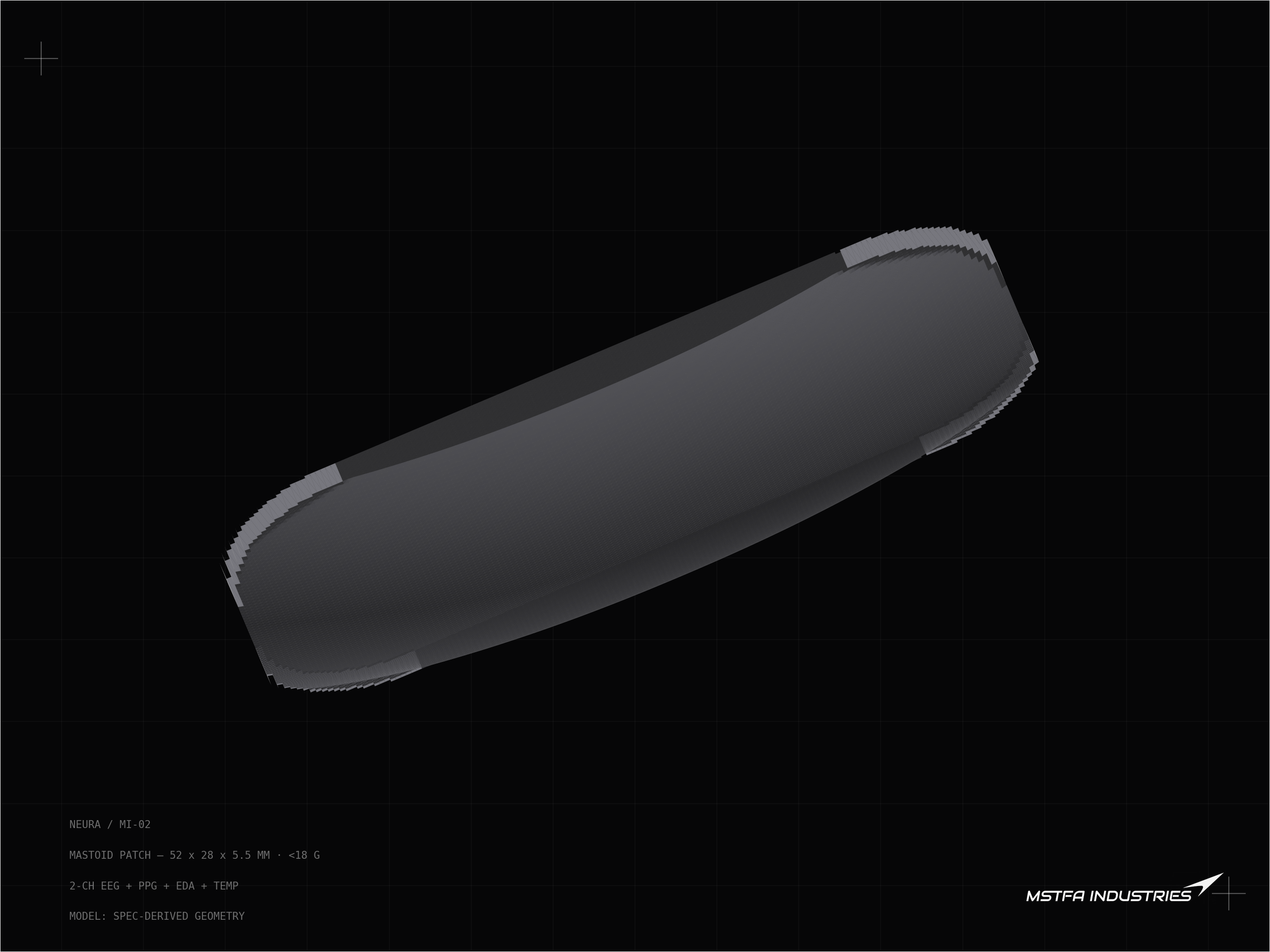
Capturing those signatures outside a laboratory requires an instrument people will actually wear. Neura's mastoid placement reaches usable EEG positions (TP9/TP10) while remaining nearly invisible in daily life.
A 12-dimension vector computed every 30 seconds on-device: band powers, HRV metrics, electrodermal events, temperature deviation — with motion-gated artifact rejection.
A gradient-boosted classifier scores structured features in real time; a sequence model evaluates longitudinal windows.
A seven-day calibration period establishes individual baselines before adaptive thresholds activate.
Training draws on public reference datasets (PhysioNet cognitive-state corpora, motion-artifact datasets), with biomarker thresholds anchored in published quantitative EEG literature — including QEEG analysis of 619 migraine patients identifying high-beta Z-score elevation as a significant biomarker.