
MSTFA / Industries
MSTFA Industries
Navigate
Home Systems Capabilities Company Investors
More
Updates Talent Contact
Systems/Pharyna

Detecting the swallow that goes wrong silently.

Pharyna is a flexible anterior-neck patch that continuously monitors swallowing function — classifying every swallow in real time and flagging silent aspiration, the invisible driver of aspiration pneumonia.

~40%
Of neurological dysphagia patients aspirate silently
300K
US aspiration-pneumonia hospitalizations / yr
2 s
Classification window, on-device
4
Swallow classes distinguished
The Problem

Silent aspiration is invisible to patient, caregiver, and bedside exam.

When material passes below the vocal folds without triggering a cough reflex, nothing outwardly changes — until pneumonia develops. Today the only reliable detection is an in-clinic videofluoroscopic swallow study.

The consequences concentrate in neurological disease: aspiration pneumonia is the leading cause of death in ALS and carries roughly 35% mortality in stroke-related aspiration. Pharyna is designed to watch continuously, where the swallow study cannot.
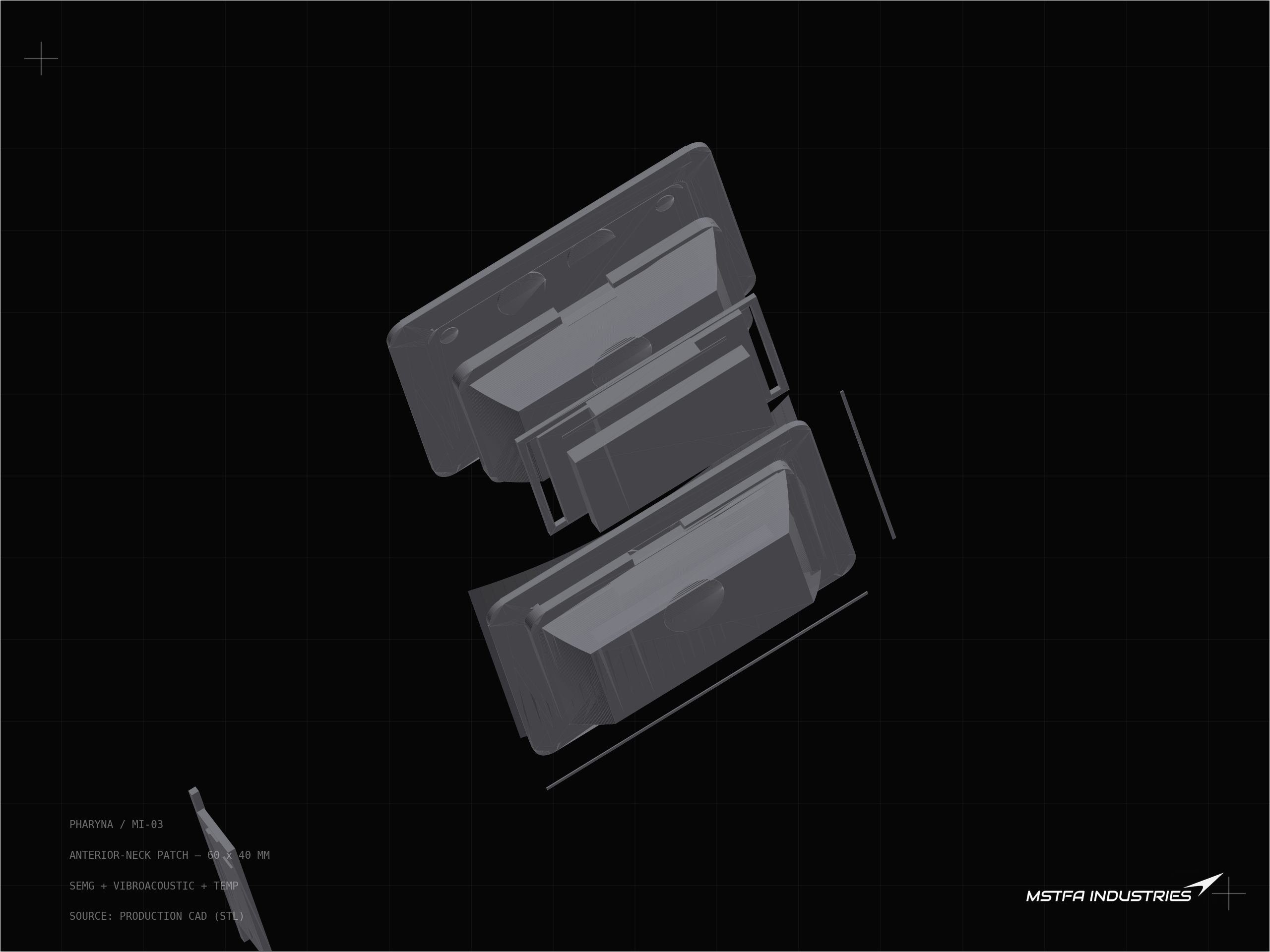
Pharyna — engineering render
Instrument

Specification.

Form factorFlexible adhesive patch, 60 × 40 mm, anterior neck, worn during waking hours — no patient interaction required
Sensor 1Surface EMG — submental and infrahyoid muscle activation during the swallow
Sensor 2Contact accelerometer / acoustic — the vibroacoustic swallow signature
Sensor 3Skin temperature — local inflammation and early infection flag
ElectronicsESP32-S3 with BLE, flexible PCB, hydrogel electrodes, 8+ hour battery, IPX4
InferenceOn-device classification over 2-second windows: normal swallow / silent aspiration / overt aspiration / non-swallow. No cloud dependency for alerting.
Pipeline

The sensing approach is established in literature.

01

Surface EMG (Park et al., 2020)

91.3% sensitivity and 88.7% specificity for swallow detection in stroke patients.

02

Neck accelerometry (Dudik et al., 2015)

89.4% accuracy for thin-liquid aspiration detection from dual-axis accelerometry.

03

Multimodal fusion (Lee et al., 2021)

sEMG + acoustic fusion outperforms single-sensor approaches by 8–14%.

04

Deep learning (Khalifa et al., 2023)

92% aspiration-detection accuracy validated against videofluoroscopy.

Development Status

Where the program stands.

StagePhase 1 clinical validation — the earliest-stage program in the portfolio.
Clinical inputInitial expert interview with a senior dysphagia specialist complete; advisory outreach in speech-language pathology in progress.
NextSensor-fusion prototype on the shared platform; classifier training against VFSS-annotated swallowing corpora.
PathwayFDA Class II 510(k), estimated 12–18 months with clinical data; predicate devices identified.

All systems     Discuss the program

All device programs are pre-clinical prototype and concept work. No MSTFA instrument is FDA cleared, CE marked, or available for clinical use.